

.png)

.png)

Keep the view, lose the glare: designing shades and lighting around the Central Oregon sun

In late June, the sun in Bend doesn't set in the west. It sets well north of west, at about 8:50 at night.
That one fact explains a lot of the rooms we walk into. A great room built around a Cascade view, a wall of west glass, and a set of shades that come all the way down around four o'clock and stay there through sunset. The homeowners love that room every morning. By late afternoon they're sitting in the dark with the lamps on, looking at fabric instead of Broken Top.
Nobody did anything wrong. The glass and the shades are fine. They just weren't designed for how the sun actually moves here, and they were never designed together with the lighting.
This post covers how we plan both: shades and lights that follow the sun on their own, move only as far as they need to, and leave the view alone the rest of the time.
The sun here moves more than you'd think
Bend sits at about 44° north. Here's what that means for a window.
Summer solstice (June 21) | Equinox (March / September) | Winter solstice (Dec 21) | |
Sunrise | 5:22 a.m., northeast | about 7:00 a.m., due east | 7:37 a.m., southeast |
Sunset | 8:51 p.m., west-northwest | about 7:00 p.m., due west | 4:29 p.m., southwest |
Sun height at midday | 69° | 46° | 22.5° |
Daylight | about 15½ hours | about 12 hours | under 9 hours |
Calculated for Bend using standard solar-position math. Times are Pacific. Close enough for design, not a substitute for a site-specific sun study.
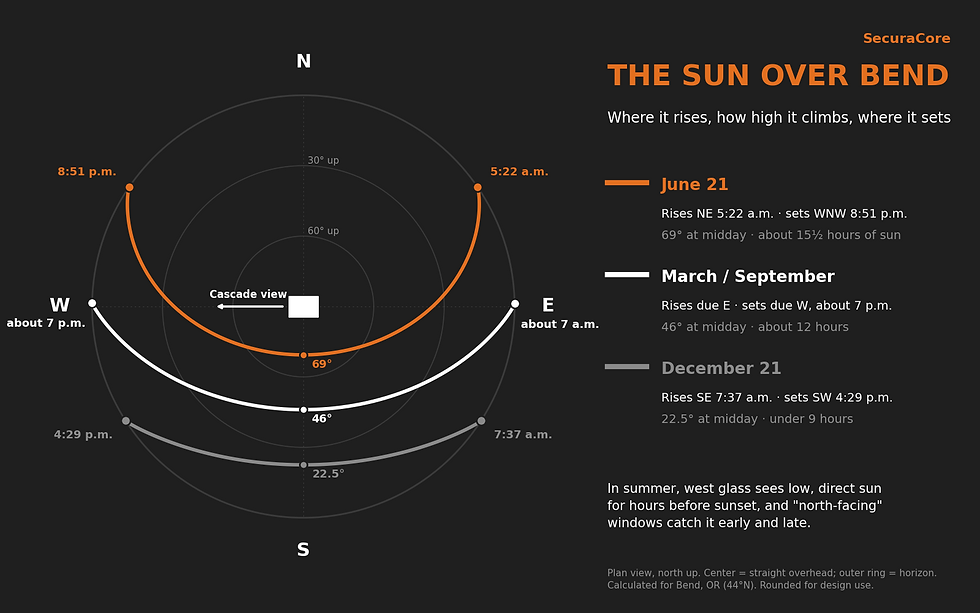
Three things in that table cause most of the trouble we see.
Summer sun comes around the corners. In June it rises well north of east and sets well north of west. Windows people think of as "north-facing" often catch direct sun early and late in the day, and corner glass gets hit from two sides.
West glass takes a long beating in summer. At 5:30 on a June evening the sun is due west and about a third of the way up the sky. At 7:30 it's about 12° up and swinging north of west, low enough to hit someone on the sofa square in the eyes. That's hours of low, direct sun on the glass you most want to look through.
Winter sun comes in low and deep. At midday in December the sun is only about 22½° up. It reaches far into south- and southwest-facing rooms. That warmth is welcome in a Bend January. The glare on the TV and the kitchen counter is not.
The practical takeaway: "west-facing" or "mountain view" isn't enough information to set up a shade. The orientation of each wall of glass, the season, and what the room is used for all change the answer.
What "too much sun" actually means
When someone says "the sun's a problem in that room," they usually mean one of four things. Figuring out which one it is matters, because each has a different fix.
Glare. The sun itself, or a hot reflection of it, in your line of sight. This is the one that sends shades all the way down.
Contrast. No direct sun, but a very bright window next to a dim room. Your eyes can't settle. This one is solved as much with lighting as with shades.
Privacy. A fabric that's great for filtering daylight while you look out often does very little at night, when the lights are on inside. Daytime view and nighttime privacy are two separate jobs.
Heat. Sun through glass is heat. In July you want less of it. In January you'd like to keep it.
One shade in one position can't handle all four, which is why we plan shades and lighting together.
Stop thinking "open or closed"
The biggest change we make on most projects is getting rid of the idea that a shade has two positions.
On a tall west window, the useful position at 5 p.m. in July is usually partway down: low enough to take the sun out of the eyes of whoever's sitting on the sofa, high enough that you still see the mountains over it.
Lutron's HomeWorks and RadioRA 3 systems can handle this automatically with a feature called Natural Light Optimization. It uses the home's latitude, longitude, and the direction each window faces to calculate where the sun is, then moves the shades between three positions: one for when direct sun is hitting that glass, one for when it isn't, and one for night. It started with blinds. In late 2024 Lutron expanded it to roller, Roman, and honeycomb shades across its Palladiom, Sivoia, and Triathlon lines.
Because it's calculated from the sun's position instead of a light sensor, it doesn't chase every passing cloud. We like that. A big wall of shades that twitches every few minutes gets old fast. The trade-off is that on an overcast afternoon it still assumes the sun is there, which is one more reason every room gets a one-touch way to pause it.
A few rules we program around, whatever the system:
Plan by direction, then tune by room. The great room and the primary bedroom may see the same west sun, but they need different answers at 7 p.m.
The homeowner always wins. If you want to watch the sunset, one press, labeled in plain English, pauses sun-tracking, and it picks back up on its own later. Automation that fights you gets turned off, and then you've paid for a motor that does nothing.
Fewer moves, on purpose. In the rooms that matter, one clear adjustment beats constant small ones.
One honest limit: Lutron's sun-tracking doesn't cover draperies or skylight shades. Automated drapery is still beautiful and still ours to program. It just runs on scenes and schedules rather than following the sun on its own.
Shades and lights are one design
This is where most projects fall short. The shades come from one vendor, the lighting from another, and nobody decides what the room should look like when a shade comes down at 4:30 on a sunny afternoon.
When a shade lowers to cut glare, the room gets darker. If nothing else changes, you reach for a lamp, turn it all the way up, and the room ends up looking patched together. When shades and lighting are on one Lutron system, they can move together as a single scene.
Here's roughly how we'd set up a west-facing great room:
Time of day | Shades | Room lighting |
Bright morning | Open | Off or very low |
Afternoon, direct west sun | Down only enough to cut the glare | Ambient light comes up a little to soften the contrast |
Golden hour, sun below the problem angle | Back up for the view | Low and warm |
Evening with friends | Privacy position where needed | Layered, art and accents up |
Movie | Down where the screen needs it | Very low |
Goodnight | Privacy or blackout | Path lights only, then off |
The homeowner doesn't operate any of that. They press Entertain, or they don't press anything at all.
Tunable lighting helps here. Lutron's Lumaris downlights shift from about 1800K to 4000K, so the same fixtures can read crisp and natural at noon and warm and low after dark. HomeWorks can also run Ketra fixtures for rooms where the quality of the light is part of the design, like around art, stone, or reclaimed timber.
You're not trying to fake daylight. You want the daylight and the lights in the room to look like they belong to the same house.
If you want to see what this feels like with one button, we wrote about how smart home scenes work.
Choose the shade by what the window is for
Before we talk fabric or model numbers, we sort every window in the house into one of four groups: primary view, secondary view, daylight only, or privacy first. The Cascade panorama in the great room and the bathroom clerestory shouldn't get the same answer.
What the window is for | What usually works | Why |
Primary view (great room, main living space) | Roller shade in a recessed ceiling pocket, or an exposed Palladiom roller | The hardware disappears or becomes deliberate. A view-oriented fabric filters sun without hiding the landscape. |
Bedroom | Honeycomb or blackout layer, often paired with a lighter daytime shade | Sleep needs dark. Daytime still wants light and privacy. Two layers do both jobs better than one. |
Lodge, transitional, or textile-heavy interiors | Roman shades in the designer's own fabric | The window treatment reads as part of the room's textiles. |
Formal rooms, large bedrooms | Automated drapery | Softness and full privacy when closed. Runs on scenes, not sun-tracking. |
Two things we push hard on.
See the fabric in the actual room. A swatch on a desk tells you almost nothing about how a fabric looks with a bright high-desert afternoon behind it. We'd rather hang a full-size sample on the real window and look at it from the sofa.
Decide on a recessed pocket before the ceiling plan is final. A shade that disappears into the ceiling is the cleanest result, but only if the pocket is framed for the real shade, with power on the correct side. We covered the details in why window header depth and dedicated power matter for recessed shades. On a remodel where the ceiling isn't opening, battery-powered shades are a legitimate answer, and Lutron's Palladiom and Triathlon battery shades still work with sun-tracking.
For more on fabric openness, finishes, and designer options, see our designer's guide to automated shades.
Choose the keypad with the door hardware
A keypad is one of the few pieces of this system you'll touch every day. It should be chosen next to the door levers and plumbing trim, not after them.
Lutron gives a design team real options. Alisse, available on HomeWorks, is solid brass, hand-finished in 11 metal finishes, with engraved buttons. Palladiom comes in metal, glass, and matte finishes that can either stand out or blend into the wall. RadioRA 3's Sunnata controls come with wallplates in 25 colors and finishes, so switches and keypads match instead of mixing.
Our rule: never approve a keypad finish from a screen. Put a real sample on the material board beside the hardware, the stone, and the paint, and look at it in daylight and again under evening light.
And engrave the buttons for what you're doing, not what's being controlled. "Morning," "Entertain," "Goodnight." Not "Zone 3 Pendants." More on that in keypads vs. switch banks.
Which Lutron system fits
HomeWorks is our recommendation for new construction and major remodels where lighting, shades, and finishes are being designed together. It has the widest choice of shades, fixtures, and keypads, including Alisse and Ketra, and it's the cleanest way to build a whole house around the light.
RadioRA 3 is our pick for finished homes and remodels. It's wireless, so it rarely means opening walls, and it still runs sun-tracking shades, tunable lighting, and full scenes. For a lot of Bend homes, it's the right answer.
Caséta is a good fit for smart dimmers and shades on a simple schedule. It doesn't do sun-tracking or tunable lighting, so if the brief is a view wall that manages itself through the seasons, you'll want one of the other two.
Not sure where your project lands? Our take on where the lighting line sits is a good place to start.
Where we'd tell you to skip it
We'd rather tell you now than sell you a motor you don't need.
Windows that never see direct sun. A true north window with no summer exposure rarely needs sun-tracking. A simple scene is enough.
Small punched windows in secondary rooms. Automation earns its place on big glass and rooms you use every day. A guest bath window doesn't need sun-tracking.
Energy savings as the reason to buy. Shades that manage solar heat can reduce cooling load, and we'll design them to. But the savings depend on your glass, your HVAC, and how you live, and we won't put a percentage on it. Buy this for comfort and for the view. Treat lower bills as a bonus.
Expecting drapery to follow the sun. It won't. Plan drapery for privacy and softness, and let roller or Roman shades do the solar work.
Tuned in real sunlight, then tuned again
Sun-tracking gets you most of the way there on day one. The last bit comes from watching the room.
We commission shade positions in real daylight, not from a laptop in the driveway at dusk, and we pay particular attention to east and west glass. Then we come back after the season turns, because a setup that's perfect in September can be wrong in June. The sun's path is different, and so is how you're using the room.
That's also when we hear the small stuff. The shade that comes down five minutes too early during dinner. The sunset you'd rather watch than block. Those are quick fixes, and they're the ones you notice most.
The point is you stop noticing
Central Oregon homes are built around what's outside the glass. Shades and lighting should keep that view usable all day.
Done right, you don't manage any of it. The shades and lights adjust as the sun moves, and you keep looking at the mountains.
Building, remodeling, or living with a west wall that fights you every afternoon? Come see Lutron shades and lighting working together at our Technology Design Center in Bend, or start a conversation and we'll walk the house with you. Designers and architects: send us the window schedule and the reflected ceiling plan early, and we'll mark up what needs to be decided before the ceiling closes. See how we work with design and build partners, and what goes on the drawings before the drywall goes up.
Explore automated shades and smart lighting from SecuraCore.
SecuraCore: Technology made simple. More Central Oregon smart home advice on our blog.
Sun positions are calculated for Bend, Oregon (about 44°N) and rounded for design use. Actual conditions vary with terrain, trees, overhangs, and neighboring buildings. Lutron product features described are as published by Lutron as of September 2026 and vary by system and shade type.


Comments