

.png)

.png)

Lutron Battery-Powered Motorized Shades | Bend & Central Oregon | SecuraCore

For years, the answer to "can we motorize these windows?" in a finished home was some version of yes, but. Yes, but we'll need to open the wall. Yes, but you'll be patching and repainting. Yes, but the window over the stairwell is going to be a problem.
Battery-powered shades removed most of that. Lutron's wire-free lines — Serena, Triathlon, and Palladiom Wire-Free — install with brackets and screws, run on D-cell batteries, and talk to the rest of the system over Lutron's own Clear Connect RF. No conduit. No electrician. No drywall dust.
We install a lot of these across Bend, Sunriver, Sisters, and Black Butte Ranch, and they solve a specific problem extremely well. They aren't the right call for every project, and we'll get to that. But if you're living in the house already, this is usually the path.
Why wire-free matters more here than most places
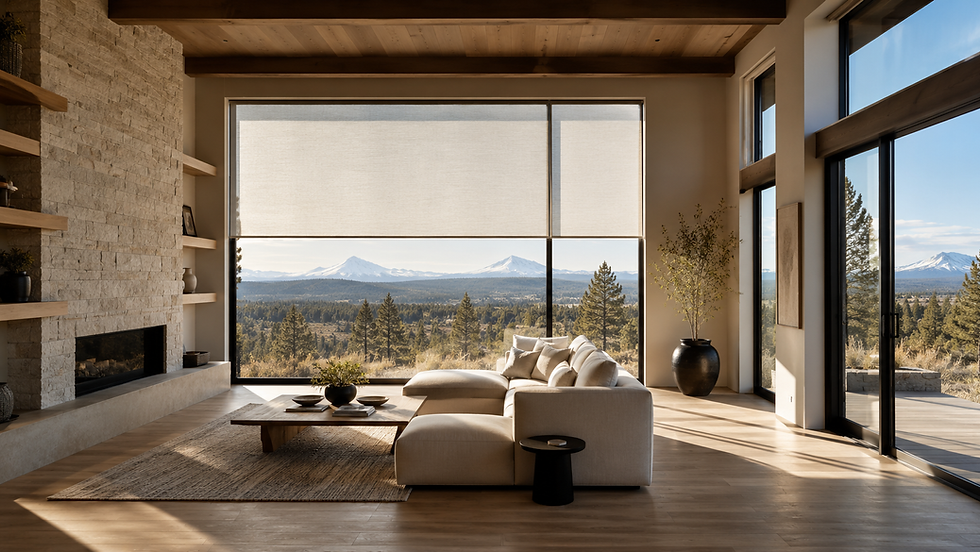
Central Oregon homes have a glass problem. That's a good problem — nobody buys a place on the west side to look at a wall — but big west-facing windows aimed at the Cascades mean afternoon glare, real solar heat gain, and UV that will fade a rug in a couple of seasons.
The homes that need shading most are often the hardest to wire. Timber-frame construction. Vaulted great rooms with clerestory windows twenty feet up. Second homes in Sunriver and Black Butte Ranch where the owner isn't around to supervise a two-week construction project, and where design review makes any exterior work a headache.
Lutron shades communicate over Clear Connect RF, which doesn't depend on line of sight — the signal travels through drapery, valances, and cornices. That matters when the shade is behind a window treatment or tucked into a pocket. It also keeps shade traffic off your Wi-Fi, which is worth something in a house already running cameras, streaming, and a dozen smart devices.
The three Lutron wire-free lines
Line | Best For | Battery Life | System Compatibility |
Serena | Single rooms, phased projects, straightforward retrofits | 3–5 years | Caséta |
Triathlon | Whole-home retrofits that need real integration | 3–5 years | RadioRA 3, HomeWorks |
Palladiom Wire-Free | Architectural windows where the hardware is meant to be seen | 3–5 years, up to six D-cell batteries | Most Lutron systems; unlocks Natural Light Optimization with HomeWorks and RadioRA 3 |
A few things worth knowing about the differences.
Serena is Lutron's accessible line. It's the entry point — battery-powered, Caséta-based, well suited to individual rooms or smaller setups.</cite> If a client wants to start with the primary bedroom and see how they feel about it, this is where we usually start.
Triathlon is the workhorse for whole-home retrofits. It runs on batteries or a plug-in power supply, and it integrates into the larger Lutron ecosystems — RadioRA 3 and HomeWorks — in a way Serena doesn't. If there's any chance the project grows into whole-home lighting control later, we spec Triathlon and skip the do-over.
Palladiom Wire-Free is the design-forward option. The brackets are hand-finished metal and exposed on purpose — meant to be seen, not hidden. It covers windows from 21 to 144 inches wide and 12 to 144 inches high, runs under 35 dBA at three feet, and carries an eight-year limited warranty. We use it when concealing the hardware isn't possible, or when the architect wants it visible.
What these actually do well
Precision across a wall of windows. Six shades along a great room have to land at the same height, or the whole thing looks wrong. Lutron's drive stops at 0.125-inch intervals through the full travel of the shade, and Triathlon drive technology compensates for fabric weight and battery voltage to hold bottom-rail alignment. Palladiom uses Intelligent Hem bar Alignment to stay within an eighth of an inch, moving or stopped. That's the difference between a motorized shade and a shade that looks motorized.
Scheduling for empty houses. This is the one second-home owners care about most. Shades that close at 2 p.m. in July protect the furnishings. Shades that move on a schedule make the house look lived in. Both happen without anyone driving out to Sunriver.
Scene control alongside lighting. Once the shades are on the same system as the lights, "Movie" becomes one button — lights to 15%, shades down, done. That's the request we get most often from home theater clients, and it's the moment the system stops being a novelty.
Where we tell clients not to use them
We'd rather have this conversation up front than at the punch list.
New construction. If the walls are open, wire them. Hardwired shades have a smaller profile, no batteries to ever think about, and over a thirty-year ownership horizon the math isn't close. Battery shades exist because retrofits are hard, not because they're better.
High shade counts. Batteries are the honest tradeoff. Three to five years is a long time on one shade. On twenty-two shades in a home with fourteen-foot ceilings, that's a service call with a lift, and it recurs. We tell clients the number before they sign, not after.
Anything you'll move constantly. Battery life assumes normal use. A shade cycling five times a day on an aggressive sun-tracking schedule will not see five years. If that's the use case, we look at a wired run or a plug-in adapter.
How we spec it
The order we work in, roughly:
Where's the sun and what's it doing? West-facing glass with a mountain view is a different problem than a north-facing bathroom.
What's the fabric supposed to do? Light-filtering keeps the view and kills the glare. Room-darkening and blackout are for bedrooms and media rooms. This decision drives more client satisfaction than the motor does.
Where does this go in three years? If lighting control is anywhere on the horizon, we're specifying Triathlon or Palladiom now.
Can we get to the headrail? Battery access is simple by design, but simple still means reachable. We flag the shades that will need a lift before we quote them.
Get those four right and the shades disappear into the house, which is the entire point.
Ready to look at your windows?
We keep working Lutron shades in the SecuraCore Technology Design Center in Bend, so you can see the fabrics, hear how quiet they actually are, and watch six shades land in a straight line before you commit to anything.
Schedule a consultation or call (541) 241-8114. We'll walk your windows and tell you honestly whether battery shades are the right answer — including when they aren't.


Comments